LMR MSI Analysis System

Characterize MSI Status of Challenging Research Samples
- New 8-marker panel, including both gold standard and novel long mononucleotide repeat (LMR) markers
- Improve clarity of microsatellite instability in samples with subtle MSI phenotypes
- Fluorescent multiplex PCR-based method using a matched normal and tumor samples
- Easier to use, less expensive and faster turnaround than NGS
Catalog Number:
Size
Catalog Number: MD2540
Resolve Microsatellite Instability Status in Challenging Sample Types
The LMR MSI Analysis System is a PCR-based method for detecting microsatellite instability (MSI) in solid tumors that will enable researchers to more precisely assess MSI status of their samples. This improved clarity is ideal for challenging samples with subtle MSI phenotypes, including those with ambiguous results or small shifts.

Increase MSI Detection Ability with Long Mononucleotide Repeat Markers
The new LMR panel is comprised of four Promega gold standard MSI markers (BAT-25, BAT-26, MONO-27 and NR-21) and four additional markers with increased repeat length (BAT-52, BAT-56, BAT-59 and BAT-60). This combination of markers provides increased MSI detection ability in difficult samples while maintaining overlap with data gathered using traditional markers. The assay has been optimized to enable strong and balanced amplification of all markers, even from challenging samples such as FFPE tissue.
Validation of LMR Markers for MSI Detection
A recent paper published by Johns Hopkins details how a research team, led by Dr. James R. Eshleman, conducted a validation of the LMR MSI Analysis System using a variety of tumor samples with previously confirmed dMMR/MSI-H status. Additionally, the study showed that the LMR markers demonstrated improved sensitivity for tumor samples that had inconclusive results in previous MSI testing. The study was supported in part by the Promega Clinical Research Program (PCRP) and is the first publication to result from a PCRP partnership.

LMR MSI Analysis Workflow
In a routine research laboratory, the time from sample input to MSI status determination can range from overnight to two days. With the LMR MSI Analysis System, you can have data ready for analysis overnight.

DNA Isolation
5 hours including incubation

Maxwell® RSC Instruments and Maxwell® RSC FFPE DNA Kit

Amplification
1+ hours

LMR MSI Analysis System

Capillary Electrophoresis
30 minutes

Promega Spectrum Compact or Applied Biosystems® 3500 Genetic Analyzer

Data Analysis
<1 hour

Customer CE Analysis Software
Clear and Confident Assessment of MSI Status
MSI analysis typically involves comparing allelic profiles of microsatellite markers generated by amplifying matched pairs of tumor and normal samples. The presence of alleles in the tumor sample that are not found in the matched normal sample are indicative of MSI.
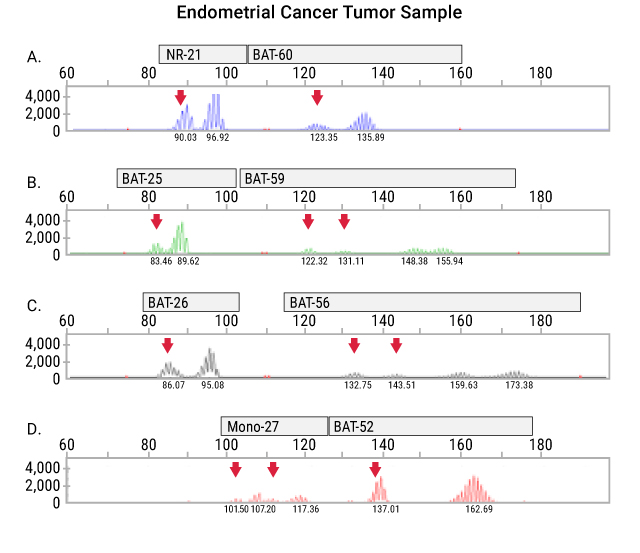
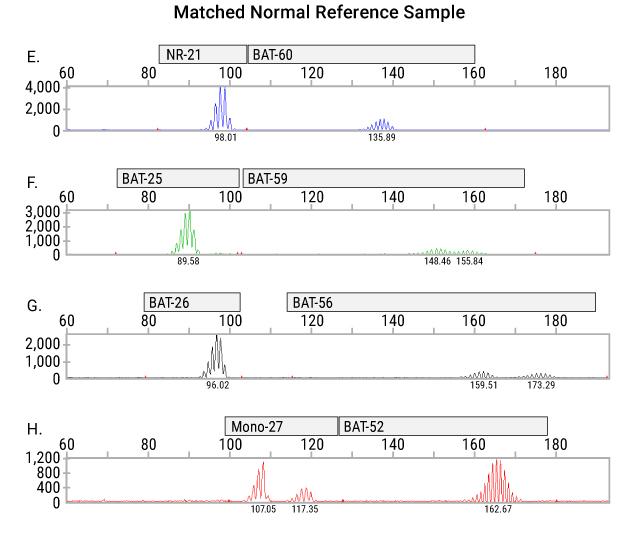
An endometrial cancer tumor sample (Panels A–D) and matched normal sample (Panels E–H) were amplified using the LMR MSI Analysis System. Fragment analysis was performed using an Applied Biosystems® 3500 Genetic Analyzer and GeneMapper® software. Red arrows indicate alleles not present in the normal sample. Note that the four new LMR markers (BAT-52, BAT-56, BAT-59 and BAT-60) are somewhat more prone to heterozygosity, with multiple peaks in the normal sample. After comparing the tumor sample to its matched normal reference sample, microsatellite instability is noted at all markers and is considered MSI-high (MSI-H).
Representative Sample Demonstrating Shift Sizes by Markers
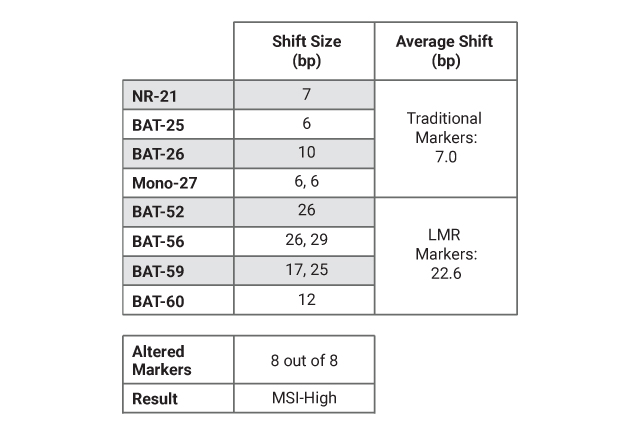
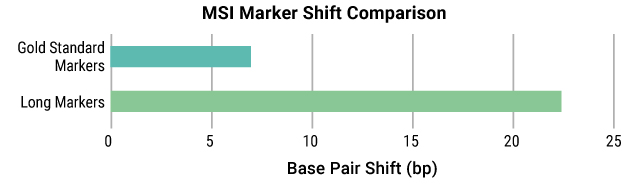
Table showing average allele shift size for example MSI-high endometrial cancer tumor sample. Note that the shift in sizes of the alleles at the LMR markers are larger (average = 22.6bp) than the shifts detected in the traditional short markers (average = 7.0bp).
Long Markers Offer a Different Perspective on MSI
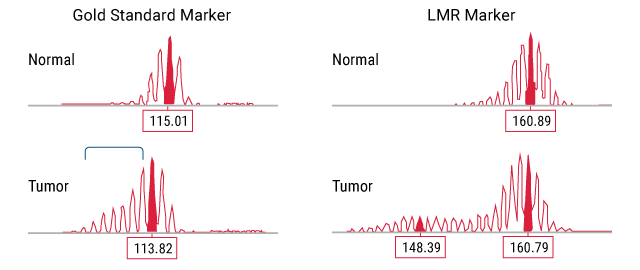
A matched pair of tumor and normal endometrial cancer samples were analyzed using the LMR MSI Analysis System. At the Gold Standard Marker, the unstable locus exhibited a small shift (denoted by the bracket) which can be difficult to classify. At the LMR Marker, the longer LMR locus exhibited a larger shift that is less ambiguous.
Seamless Support for Adopting LMR MSI in Your Research Lab
Our team is dedicated to partnering with you to ensure success and has broad experience training laboratories. We offer an online user training course as well as an in-person training option to get your lab up and running efficiently with the LMR MSI Analysis System.
MSI Analysis is a Valuable Tool in Research and Tumor Screening


MSI panels and bins for GeneMapper® software can be downloaded for consistent data analysis. Panels and bins text files simplify and standardize data analysis by providing automated assignment of genotypes using GeneMapper® 4.0, 4.1, 5.0 and 6.0 software.
Protocols
Complete Protocol
Specifications
Catalog Number:
Lieferumfang
| Produkt | Katalognummer | Größe | Konzentration | Available Separately |
|---|---|---|---|---|
LMR MSI 5X Primer Mix |
MD232A | 1 × 200μl | ||
LMR MSI 5X Master Mix |
MD233A | 1 × 200μl | ||
|
2800M Control DNA |
DD710A | 1 × 25μl | 10ng/μl | View Product |
WEN Internal Lane Standard 500 |
DG500A | 1 × 200μl | View Product | |
|
Water, Amplification Grade |
DW099A | 1 × 1,250μl | View Product |
SDS
Search for SDSAnalysezertifikat
Nutzungseinschränkung
For Research Use Only. Not for Use in Diagnostic Procedures.Lagerhinweise

TMR-ET, CXR-ET and WEN dyes are proprietary.
Resources
Erwähnungen in der Fachliteratur
Zusätzliches Informationsmaterial
- Paper: Validation of Long Mononucleotide Repeat Markers for Detection of Microsatellite Instability
- Paper: Improved Detection of Microsatellite Instability in Early Colorectal Lesions
- Application Note: Detecting Microsatellite Instability with the LMR MSI Analysis System and the Spectrum Compact CE System
- White Paper: Using the Spectrum Compact CE System for MSI Analysis
Related Products
Ähnliche Produkte
Wird oft zusammen gekauft
QuantiFluor® dsDNA System
Specific, sensitive dsDNA quantitation system.
E2670, E2671
QuantiFluor® ONE dsDNA System
"Add-and-read" quantitation of double-stranded DNA. Includes DNA-binding dye, lambda DNA and buffer.
E4871, E4870
Maxwell® RSC DNA FFPE Kit
Automated DNA extraction from 1–16 FFPE tissues using the Maxwell® RSC Instrument.
AS1450, ASB1450