Energiemetabolismus
Effektive Assays zur Bestimmung der metabolischen Aktivtität von Zellen wie Glucoseaufnahme, Oxidativer Stress und Dinukleotid-Bestimmung. Die nicht radioaktiven, biolumineszenten Methoden zur Messung metabolischer Änderungen sind wertvolle Werkzeuge, um die Gesundheit von Zellen und Krankheiten besser zu verstehen.
Find the Right Metabolic Activity Assay For Your Experiment
We offer a portfolio of ready-to-use assays to measure metabolic activity, including glucose uptake, lactate, glutamine, oxidative stress and dinucleotide detection assays. These non-radioactive, bioluminescent methods for measuring metabolic changes are powerful research tools for studying cell health.
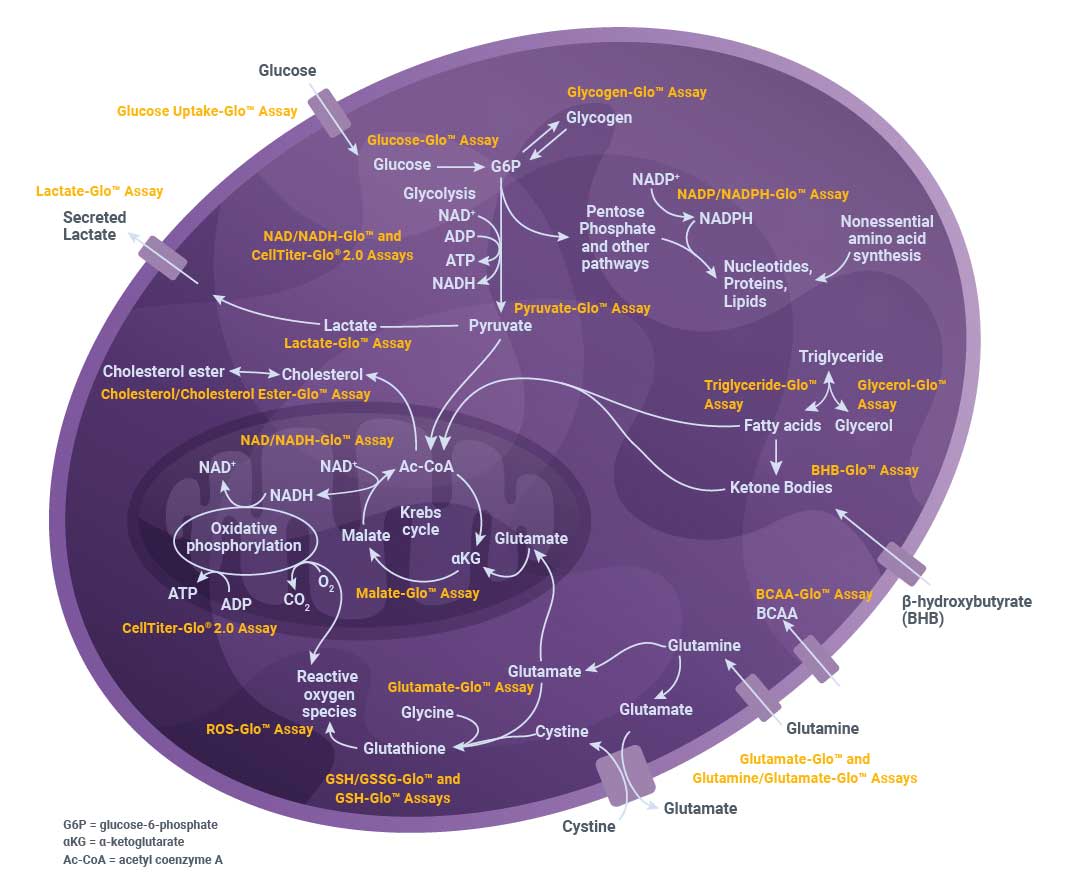
Want a closer look at the metabolic map? Download the Cellular Energy Metabolism Wall Chart to view in more detail.
Available Assays
Mitochondrial Function
and Oxidative Stress
CellTiter-Glo® 2.0 Cell Viability Assay
Not seeing your target? Try our DIY kits.
Energiemetabolismus Produktgruppen
Lipid Metabolism
Bioluminescent assays for quantitating glycerol, triglyceride, cholesterol and cholesterol esters in a variety of biological samples.
Metabolische Assays
Biolumineszente Assays zum Nachweis von Glucose, Glutamat, Gluatamin und Laktat, sowie zur Quantifizierung der Glucoseaufnahme.
Oxidativer Stress
Assays zur Bestimmung reaktiver Sauerstoffspezies sowie zur Messung des Verhältnisses von reduziertem zu oxidiertem Glutathion.
Dinukleotid Detektionsassays
Biolumineszente Assays zur Bestimmung phosphorylierter und nicht phosphorylierter Formen oxidierter und reduzierter Nicotinamidadenindinukleotide in biochemischen oder zellbasierten Anwendungen.
Top Energiemetabolismus-Produkte für Ihr Labor
Glucose Uptake-Glo™ Assay
Non-radioactive assay for measuring glucose uptake.
J1341, J1342, J1343
Lactate-Glo™ Assay
Biolomunescent assay that quickly detect lactate from a variety of sample types.
J5021, J5022
NAD(P)H-Glo™ Detection System
A homogeneous, bioluminescent assay that quantitatively monitors the concentration of the reduced forms of NADH and NADPH
G9061, G9062

What is Cell Metabolism?
Cells must perform a balancing act of maintaining energy levels, biosynthesis of new material, and controlling reactive oxygen species created by energy generation. Promega’s portfolio of metabolic assays help researchers understand this balancing act performed by cells, along with changes in metabolic pathways due to therapeutic treatments.
Monitoring metabolites in cell culture medium can provide information about cellular metabolic pathways. Glucose consumption and lactate secretion can serve as indicators of glycolysis, while glutamine consumption and glutamate secretion provide information about glutaminolysis. Glucose uptake rate can also be evaluated, related to diabetes, cancer and immune cell activation.
Nicotinamide adenine dinucleotides are abundant soluble cofactors that undergo reversible oxidation and reduction in major metabolic pathways. They can tie metabolic pathways to transcriptional control, epigenetics and cell signaling as cells switch from a normal metabolism to a cancer cell (proliferative) metabolism. These dinucleotides work in pairs, either phosphorylated NADP and NADPH or unphosphorylated NAD and NADH. Each pair has distinct functions. Assay kits can be used to measure the total, oxidized and reduced versions of the nucleotides. ATP, the abundant nucleotide used for intracellular energy transfer can be measured with the CellTiter-Glo® Assays.
Oxidative stress level as a cellular response is linked to cellular metabolism. Cells generate Reactive Oxygen Species (ROS) as a result of increased metabolism or as a stress response. Glutathione (GSH), an antioxidant, is used to mitigate the damage of ROS. Oxidative Stress assays that measure ROS or GSH (total and reduced) levels are related to the metabolic state of the cell.
Bioluminescent, plate-reader based assays to monitor these processes give researchers the ability to measure many samples with simple sample processing requirements. The sensitive assays conserve starting samples, which may be cells grown in monolayer culture or 3D models, tissues, or other biological samples.